Pages

Showing posts with label Women. Show all posts

Wednesday, 14 December 2016

Pink and Consent in Hindi Films

A couple of months after the December 2012 gang-rape in Delhi (probably the watershed for discussions of gender justice and consent in India) I was travelling in the general compartment of a reasonably crowded metro. I was standing near a row of seats occupied at one end by two middle aged women, most likely returning home from work. A feet from me, stood a young couple, holding hands and making calf eyes at each other. Adequately repulsed by their PDA (as prudish young women are wont to) I proceeded to eavesdrop on the middle aged women. Apparently they didn’t approve of the PDA either, going on to assert that ‘these’ (referring to the female half of the couple) are the kind of young women who first ‘make’ young men fall in love with them and then cry rape. 

From a neutral perspective, Pink is an above-average movie. The first half is crafted like a thriller, and in spite of all the stomach churning scenes (and as a woman in Delhi, your stomach is bound to churn), it holds your interest. The second half however is unrelentingly preachy with Amitabh Bachchan’s baritone doing everything to convince you that no means no.  From the perspective of a person with vested interest however (that is, an average urban woman facing close mindedness from aunties in the metro, neighbourhood uncles, family friends and relatives), the second half of Pink is like a well-made pamphlet for propaganda of the feminist cause.

And you have to admit that this is a reason for some happiness. After all, as late as 1980, the same Amitabh Bachchan was lecturing Zeenat Aman to wear more clothes to the beach as a solution to avoid others’ lechery. He helpfully tells her, “aise kapdo mein aapko seetiyan nahi sunayi degi toh kya mandir ki ghantiya sunayi degi”. Did I mention he was a cop?


Then in 1990, in Ghar ho toh aisa, Anil Kapoor harasses his secretary into changing out of her modern clothes into “decent” ones. Of course he may have been commenting on her fashion sense (the dress was truly hideous, see pic below), but his elation at seeing her wear a sari later (“inn kapdo mein tum shareef ghar ki ladki lag rahi ho”) puts an end to such hopes. And I am not even going to go into the numerous successful attempts by Jeetendra to stalk, molest and generally harass Sridevi into dating him.
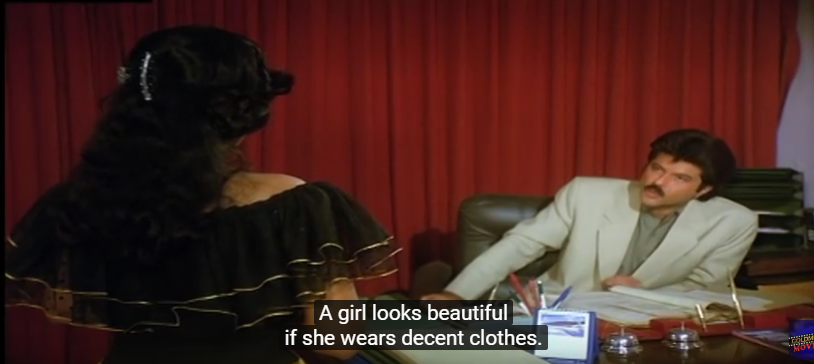


The most egregious failure to understand matters of consent was of course Dilwale Dulhaniya Le Jayenge, an all-time favourite for many young people. 


Waking up after a night of drinking, Raj convinces Simran that the two of them had sex the previous night. Simran does not remember anything about the night and quite justifiably, freaks out. Raj tries to calm her down and admits he was joking. And then he tells her that he knows she is Indian, and therefore understands the importance of her virtue. The point about the ‘bad boy’ not being evil could have been equally well made if he had pointed out that Indian or not, if he had had sex with a girl too drunk to have given her consent, it would be rape. But maybe that wouldn’t have had the NRIs cheering…

In Raaja Ayegi Baraat, Rani Mukherjee marries her rapist (apparently not an uncommon outcome of the great justice system’s working in India) and makes nice with him even as the rest of the family plots to off her. But even in the better made, YRF sanctioned Ishaqzaade, Arjun Kapoor has sex with Parineeti Chopra under false pretences (still rape). Not only does she forgive him, but by the end of the movie they are a pair of star crossed lovers killed by their feuding families.

In fact the only time at the movies when I felt satisfied with the consequences faced by men when they treated women badly, was Chak de India.


At a visceral level, this was more satisfying than the favourable court verdict in Pink, which I know reflects quite poorly on me. Of course a court mandated punishment is better for democracy than a public lynching. Yet this scene allows its women to vent their frustration that Indian women (or at least I) feel on a daily basis and cannot express, while also doing justice to the characters (watch how Bindiya trips one of the goons while continuing to sit with a certain amount of detachment).

There is a second non-cinematic, illogical reason why Pink did not make me rave. At one point, Falak points out that even if they were sex workers but withdrew their consent at any point, it would still be assault. For that moment, I suddenly wished that that had been the storyline. I thought back to an episode of the serial Sidhhant, a courtroom drama that used to play on Star One while I was still in school. I only have vague memories of it (and I can’t find a link online) but that had been my introduction to the issues of consent. And if a television serial could tackle that a decade earlier, there is no reason why a movie with that many resources at its disposal could not be slightly bolder.

Saturday, 1 March 2014

Please Baba, aar five minutes khelbo...

Unlike my friend, the Mutinous Scribe, I care deeply about Imtiaz Ali's filmography.

I have, since the day I stumbled on to Socha Na Tha on t.v*.
In one scene, the hero and heroine are in Goa and facing the prospect of sharing a room together. (They aren't in love yet). The heroine tells the hero, "Ghabrao nahi, main tumhare izzat pe haath nahi dalungi."
That nonchalance, the non-drama was refreshing then to a child of the nineties for whom the Hindi film heroine was always a bit of a tight-ass paragon of virtue.
Geet in Jab We Met was even better etched, with lovely shades of so many people I knew. Self-obsessed, talkative, feisty, and armed with a healthy sense of adventure. And then came Veera**, who on the outside, was in the same mould as Geet. When she hides herself in the truck during the police search, and Aadu, the genial goon asks her why, I didn't need her to answer. It was just what an Imtiaz Ali heroine did.

Except it wasn't. While Geet's flight came from the protected, indulgent child-hood she had had, Veera's was a result of her cloistered one. And it wasn't a sense of adventure, as I came to learn a bit later in the film, it was a need to escape, a need to enjoy her new-found freedom. I wouldn't say that this need or feeling resonated with me, because it didn't, at least not at the time I was watching the film. There was so much else to take in-the characters, the acting (thanks to the casting-everyone, down to the creepy molester goon, was perfect), the visuals of the great Indian countryside (which I admittedly wouldn't care for, in a lesser film), the music (it is all I listen to, anymore), the world that Ali transports us to (so much so that the police shooting, in spite of its inevitability, felt like an intrusion in an otherwise idyllic life),  the "neat" story-telling (Mahabir dying before he was put on the stretcher). But the reason that all of this came together, the reason that I understood and accepted Veera's longing for the journey to continue (even if it was with her kidnapper), was possibly because I have wanted the same at different points in time.
Did I have a traumatic childhood? Far from it.

But who as a child has not wanted to play for "five more minutes", because home was boring place in your sister's board years? Which child hasn't dreaded the last week of the summer holidays when all the pending homework would have to be squeezed in? Which harassed masters student has not wanted to run away before a game theory/ econometrics exam? In fact, I only realised why I loved Highway the way I did, four days after I had seen the film, as I listened to "Patakha Guddi"on my way to office, in the white cab that dutifully carries me there and back every working day.


*And not since the day I realised I went to the same college as him.
**Yeah, I just pretended that Love Aaj Kal and Rockstar didn't happen.

Saturday, 6 July 2013

My Grist with Western Formals


  • It's the first step by Corporations at homogenising people, throttling overt displays of individuality.
  • A kurta clad, jhola toting individual does not have to be a rabble-rousing commie. So don't give me shaky logic about reflecting 'professionalism'. (Also, anybody who believes that it's the first step by Corporations at homogenising people, does not have to be a rabble-rousing commie)
  • They are shit expensive
  • They are really not suited to the Indian body type. At least to not a person with an Indian body type with curves thrown in at exactly the wrong spots.
  • Related to the previous point, they have a way of making a person with an Indian body type (with curves thrown in at exactly the wrong spots) feel really bad about herself. A Fabindia Medium can barely squeeze into a Van Heusen Extra Large.
  • There is not enough choice for women. (If someone with access to all the brands that post-1991 India has to offer, says this, he/she is definitely not a rabble-rousing commie).

Saturday, 15 June 2013

The Chink in Agatha Christie's Armour

 In college, my Monday afternoons went towards attending meetings of the Quiz Society. At the starting of the year, we divided up into groups of two, each group responsible for conducting about one quiz every two months on a rotational basis. The rest of the society would participate.
A bad quiz to my eyes, were those coming under the broad heading of Pop Culture quizzes, concentrating almost exclusively on the Godfather films (that I hadn’t seen), and a couple of bands I had never heard (okay fine, I don’t really listen to anything besides Bollywood).
A good quiz on the other hand was universally recognized as one with questions that were workout-able. The emphasis was on how much the quizzers could figure out from the clues in the question, rather than how much they knew.
The same metric should equally be applicable to detective fiction. After all, the primary pleasure in reading these arises from solving the mystery, along with the detective.  By this standard, anything that Agatha Christie wrote would come out tops. It helped that her detectives were regular people, amateurs and even when not, they relied more on order and method than on brilliance. In contrast, if Sherlock Holmes were to occupy a guest-bedroom in Styles Court or Chimneys, the solution would be forthcoming in a matter of minutes. Thus, it’s only right that he features in fantastical settings where his intelligence is suitably challenged. And where readers have no inkling as to where things are heading.
Going back to Christie, a delightful aspect of her writing is her repertoire of heroines. As is to be expected, they are morally upright but in a very unprincipled sort of way. While they pursue noble ends-to clear the name of a fiancé, or to seek the truth in their quest for adventure, they are not shy of fibbing or outright manipulation, when these are required. Even the secondary female characters are interesting. Consider Ms. Percehouse in the Sittaford Mystery. When her nephew talks of her, she comes across as a caricature of the typical old spinster-a lonely curmudgeon. When the readers see her for the first time however, you realise that she is a curmudgeon, but only in the eyes of her nephew, who she sets to work around her home. She herself wishes that the nephew stood up to her bullying at times. He would appear more sincere if he did. Moreover, she combines this good judgement of character with a healthy curiosity, making her altogether a most real person.
The problem arises when the readers start expecting every female character to be ‘strong’. And suspecting everyone who is not.  So, when an elderly spinster is described as intelligent at the beginning, and she says “Men are deeper thinkers than women”, you can’t help but feel that she is being disingenuous, and you are already on your guard. Or when others commiserate with a character who is helpless, described as having “no money or place to go”, you wonder why she also lacks initiative. And true enough, she turns out to have that in abundance. So much so, that she turns out to be the master-mind of the entire problem.
Then again, in the Sittaford mystery, I kept suspecting the Willett mother-daughter duo have to be culpable somehow, since the daughter couldn’t just be a “pretty girl-scraggy,” who took to squealing and fainting, when something slightly sinister happened.
Yes, I could have titled the post: "Christie can do no Wrong"