New Years project to post one happy/ funny thought a day
No matter whether you're 16 and trying to organise a class assembly overnight, or 26 and writing essays for B-school applications, faffing always carries the day.
New Years project to post one happy/ funny thought a day
I went gym hopping today to ask about membership plans and fees. Since it's a new year, I wasn't the only one doing it. Met the same people at all the three gyms I visited.
A couple of months after the December 2012 gang-rape in
Delhi (probably the watershed for discussions of gender justice and consent in
India) I was travelling in the general compartment of a reasonably crowded
metro. I was standing near a row of seats occupied at one end by two middle
aged women, most likely returning home from work. A feet from me, stood a young
couple, holding hands and making calf eyes at each other. Adequately repulsed
by their PDA (as prudish young women are wont to) I proceeded to eavesdrop on
the middle aged women. Apparently they didn’t approve of the PDA either, going
on to assert that ‘these’ (referring to the female half of the couple) are the
kind of young women who first ‘make’ young men fall in love with them and then
cry rape.
From a neutral perspective, Pink is an above-average movie.
The first half is crafted like a thriller, and in spite of all the stomach
churning scenes (and as a woman in Delhi, your stomach is bound to churn), it
holds your interest. The second half however is unrelentingly preachy with
Amitabh Bachchan’s baritone doing everything to convince you that no means no. From the perspective of a person with vested
interest however (that is, an average urban woman facing close mindedness from
aunties in the metro, neighbourhood uncles, family friends and relatives), the
second half of Pink is like a well-made pamphlet for propaganda of the feminist
cause.
And you have to admit that this is a reason for some
happiness. After all, as late as 1980, the same Amitabh Bachchan was lecturing
Zeenat Aman to wear more clothes to the beach as a solution to avoid others’
lechery. He helpfully tells her, “aise kapdo mein aapko seetiyan nahi sunayi
degi toh kya mandir ki ghantiya sunayi degi”. Did I mention he was a cop?
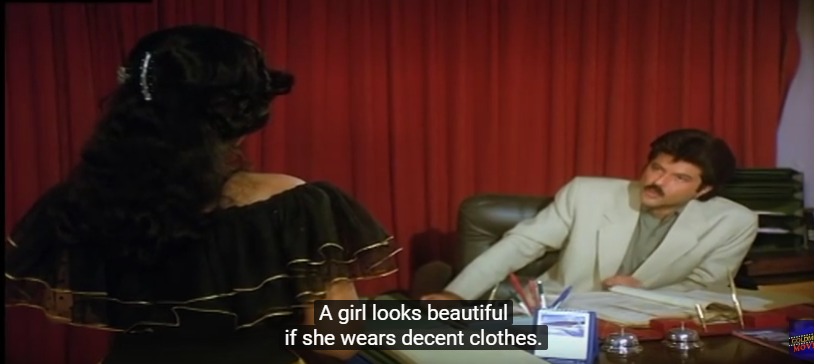
Then in 1990, in Ghar ho toh aisa, Anil Kapoor harasses his secretary
into changing out of her modern clothes into “decent” ones. Of course he may
have been commenting on her fashion sense (the dress was truly hideous, see pic
below), but his elation at seeing her wear a sari later (“inn kapdo mein tum
shareef ghar ki ladki lag rahi ho”) puts an end to such hopes. And I am not even going to go into the numerous successful attempts by Jeetendra to stalk, molest and generally harass Sridevi into dating him.
The most egregious failure to understand matters of consent
was of course Dilwale Dulhaniya Le Jayenge, an all-time favourite for many young
people.
Waking up after a night of drinking, Raj convinces Simran that the two
of them had sex the previous night. Simran does not remember anything about the
night and quite justifiably, freaks out. Raj tries to calm her down and admits
he was joking. And then he tells her that he knows she is Indian, and therefore
understands the importance of her virtue. The point about the ‘bad boy’ not
being evil could have been equally well made if he had pointed out that Indian
or not, if he had had sex with a girl too drunk to have given her consent, it
would be rape. But maybe that wouldn’t have had the NRIs cheering…
In Raaja Ayegi Baraat, Rani Mukherjee marries her rapist (apparently
not an uncommon outcome of the great justice system’s working in India) and
makes nice with him even as the rest of the family plots to off her. But even
in the better made, YRF sanctioned Ishaqzaade, Arjun Kapoor has sex with
Parineeti Chopra under false pretences (still rape). Not only does she forgive
him, but by the end of the movie they are a pair of star crossed lovers killed
by their feuding families.
In fact the only time at the movies when I felt satisfied
with the consequences faced by men when they treated women badly, was Chak de
India.
At a visceral level, this was more satisfying than the
favourable court verdict in Pink, which I know reflects quite poorly on me. Of
course a court mandated punishment is better for democracy than a public
lynching. Yet this scene allows its women to vent their frustration that Indian
women (or at least I) feel on a daily basis and cannot express, while also doing justice to the
characters (watch how Bindiya trips one of the goons while continuing to sit
with a certain amount of detachment).
There is a second non-cinematic, illogical reason why Pink
did not make me rave. At one point, Falak points out that even if they were sex
workers but withdrew their consent at any point, it would still be assault. For
that moment, I suddenly wished that that had
been the storyline. I thought back to an episode of the serial Sidhhant, a
courtroom drama that used to play on Star One while I was still in school. I
only have vague memories of it (and I can’t find a link online) but that had
been my introduction to the issues of consent. And if a television serial could
tackle that a decade earlier, there is no reason why a movie with that many
resources at its disposal could not be slightly
bolder.
There is a frightening possibility that all the bad things I say tend to come true. I always thought that it happened, but I took it as an amusing coincidence. But last week, just to irritate my sister, I predicted that her end of year vacations would get cancelled. I didn't even mean it. Turns out that I was accurate in even how it would all play out. And given how flippantly I talk of gruesome deaths and world annihilation, I have decided it is time to stop being so negative. Well I can still think it, but I won't say it.
PS: I also tried to think back to something good I had said that came true. Turns out I can't remember the last time I had been positive about the future.
PPS: To think of it, I had said that from the trailer, Fantastic Beasts seemed to be better than the Potter movies. Of course I was right.
Tuesday, 25 October 2016
"You know, today's nut may be tomorrow's prophet. The essence of free speech is to preserve the opportunity for nuts to turn into prophets."
Does Janmashtami mean anything to anyone anymore besides dp changes and inspirational Watsapp forwards?
My colony, which has a surfeit of little children on other days, had a grand total of one tiny jhanki made by a little girl, right outside the gate to her home.
People outside my colony were more enthusiastic. One group of people had hired trucks to ferry children screaming devotional slogans, in turn drowned by devotional music blaring out of speakers. There was also a chariot with two children dressed as Radha-Krishna. (I have a feeling that both of them were girls). And of course they blocked traffic.
As is my yearly ritual on this day, I pined for my childhood when my friends (and enemies) and I, struck the right balance between religious fervour and maintaining public decorum.
I don't think I celebrate any festival anymore. I have always hated Diwali, have lacked the safe space to play Holi for many years now, Janmashtami ended with my Board year (as far as I remember), Christmas and New Years were/ are generally followed by exams, I have no taste for sewai, or Kumar Sanu-Alka Yagnik Bollywood Nights and Durga Puja has become this thing where I mark mandatory attendance every year, to promptly avoid other Bengalis my age by staring at my phone.
I would also like to open up about how I mark the three national holidays but am really afraid I will be called anti-national, so I will refrain.
I would have called this post something festive had I not wanted to add a few other pointless observations and conclusions about random things.
People should marry much younger people. Then these much younger spouses are in a better position to tend to you in your sickness than spouses who are closer to you in age. Of course, not everyone can marry people much younger to them. But since the readership of this blog is rather limited, you are in luck.
People should have children late in life. Then when they are old and sick, they can have relatively young, fit people to tend to them.
I think I am as grown up now, as I am likely to ever be. All the floundering, indecisive adults around me make me feel so.
I deeply want to be South Indian.
Or at least know the four languages there. Because otherwise it is impossible
to remember that Therukoothu is a dance form in TN, Pavakoothu a form of rod
puppetry in Kerala, Kudiyattam, a theatre form in Kerala and but Kavadiattam
a dance in Tamil Nadu. Why can’t you at least use different sounding
words so that stupid-exam givers (the exam being stupid, not the givers) can
devise mnemonics to remember what infernal dance/ puppetry/ theatre form
belongs to which state?
It is worth noting how many
people say they want to clear the UPSC/ CSE exam, versus the numbers who say they
want to be in the IAS/ IPS/ IFS etc. What does UPSC aspirant even mean? UPSC is
the recruitment agency! Do you want to be the recruiting agency?
If you say you are an IAS/ Civil
Service aspirant, you are only linguistically correct. Because you have to be a
dumbass to aspire to a generic administrative designation.
Bomalattam is string
puppetry from Tamil Nadu but Tholu Bommalata is shadow puppetry
in Andhra Pradesh. WHAT IS WRONG WITH YOU PEOPLE?
India is the seventh largest
country in the world by area, second largest by population. Azerbaijan is 119th
by area, 89th by population. The latter has a Kashmir too-Nagorno
Karabakh. Of course I am simplifying, but the point is that we will be
hard-pressed to find a country where a certain section does not want to
‘leave’.
I don’t want Kashmir to leave
India. Now that I have learnt that the Kashmiri New Year is called Navreh, that
their dances are called Rouff and Dhumal, that they practice a form of folk
theatre called Bhand Pather and their folk music is called Gulraj. Or it may be
it is the little Sanghi inside me. In my defence, if I were British, I would
oppose Brexit too.
I know feelings are not facts,
except when you have fever. Then, what you feel is far more important than the
99.4 temperature that the thermometer insists on showing.
There is a theatre form called
Maach. That’s one of three Bengali phrases every non Bengali knows (maach
khabo, jol khabo, and Kemon acho, said in a very weird sheepish tone). But is
this theatre form from Bengal? No, it’s from MP, which is not even coastal!
Matlab even Odisha or Andhra or Maharashtra would be easy to remember!
Though come to think of it, why
would you call a puppetry form from any state, as generic a term as Fish?
Lest we think that a Qandeel
Baloch would not happen in India-at least the Twitter folks would lay off
celebrating an honour killing-we should remember that India does worse than
Pakistan on the Gender Development Index as well as the Gender Inequality
Index.
Bhavai is a dance form in
Rajasthan as well as a theatre form in Gujarat.
According to an OECD Survey in
2014, India has the second highest proportion of people surveyed who said they
trusted the national government. Switzerland holds the top rank [which means
that the Scandinavian countries rank behind us]. In case you think this is a jabra-fans driven exercise, note that
the proportion of people who trusted the government in 2014 was actually a decrease over the proportion recorded in
the previous version of the survey in 2007. I guess the idiot media is to
blame.
I know I have it on the blog
about how Hinduism is diverse and allows space for hedonism/ atheism. But it’s
also true that this may be the case for other religions, and we are simply not
aware. For example, Islam had the Mutazila school that believed in
monism-essentially there being no difference between the creators and the
created. Sure it faced opposition from the orthodox, but then that’s pretty
much their job description.
Latest edition of how things
never change:
The Vernacular Press Act sought
to impose pre-censorship on the Vernacular Newspapers that were considerably
bolder in their criticism of the British government than the English
newspapers. It empowered the police to also confiscate the printing materials
of the newspapers, if they were found to be publishing seditious things.
An educational committee led by
Hunter in 1882 suggested that there be a two track education system-the more
deserving students get to have a higher secondary and University education,
while the not-as-good students get to choose a vocation and have a commercial
career.
A Raleigh Commission of 1904 also
suggested that more time be spent on academics and research in our universities,
otherwise known as ‘dens of political activity’.